全国100所名校最新高考冲刺卷英语2023届Y1

全国100所名校最新高考冲刺卷英语2023届Y1,目前趣答答案已经汇总了全国100所名校最新高考冲刺卷英语2023届Y1的各科答案和试卷,获取更多{{papers_name}}答案解析,请在关注本站。
本文从以下几个角度介绍。
-
1、全国100所名校最新高考冲刺卷英语2024
2、2023-2024全国一百所名校最新高考冲刺卷英语
3、2023-2024全国100所名校最新高考冲刺卷英语一
4、2023-2024全国100所名校最新高考冲刺卷答案英语
5、2023-2024全国100所名校最新高考冲刺卷英语三答案
6、2023-2024全国100所名校最新高考冲刺卷21ccj英语
7、2024全国100所名校最新高考冲刺卷二英语
8、2023-2024全国100所名校最新高考冲刺卷二英语
9、全国100所名校最新高考冲刺卷英语一2024
10、2023-2024全国100所名校最新高考冲刺卷英语一答案
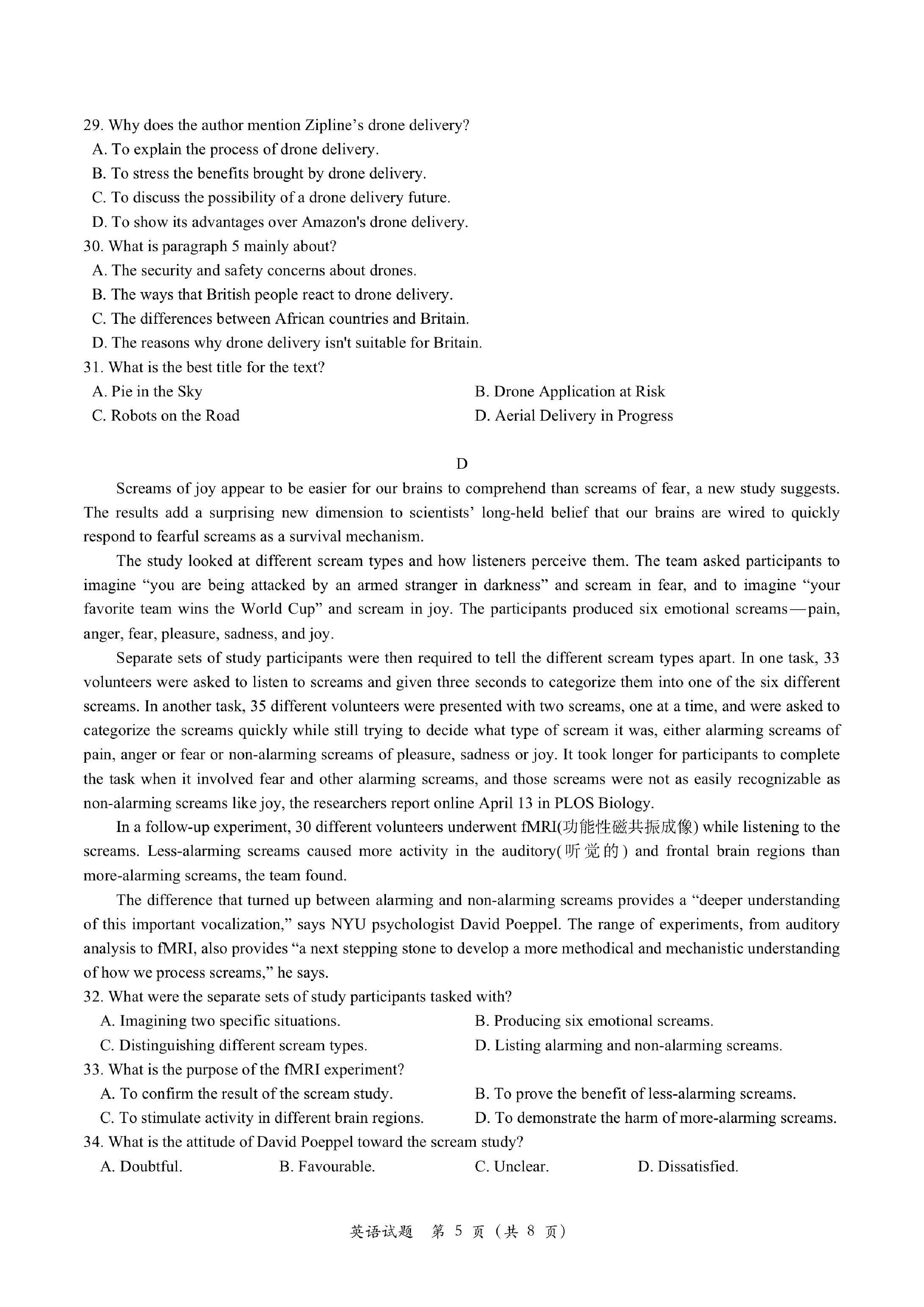 29.Why does the author mention Zipline's drone delivery?A.To explain the process of drone delivery.B.To stress the benefits brought by drone delivery.C.To discuss the possibility of a drone delivery futureD.To show its advantages over Amazon's drone delivery.30.What is paragraph 5 mainly about?A.The security and safety concerns about drones.B.The ways that British people react to drone delivery.C.The differences between African countries and Britain.D.The reasons why drone delivery isn't suitable for Britain.31.What is the best title for the text?A.Pie in the SkyB.Drone Application at RiskC.Robots on the RoadD.Aerial Delivery in Progress0Screams of joy appear to be easier for our brains to comprehend than screams of fear,a new study suggests.The results add a surprising new dimension to scientists'long-held belief that our brains are wired to quicklyrespond to fearful screams as a survival mechanism.The study looked at different scream types and how listeners perceive them.The team asked participants toimagine "you are being attacked by an armed stranger in darkness"and scream in fear,and to imagine "yourfavorite team wins the World Cup"and scream in joy.The participants produced six emotional screams-pain,anger,fear,pleasure,sadness,and joy.Separate sets of study participants were then required to tell the different scream types apart.In one task,33volunteers were asked to listen to screams and given three seconds to categorize them into one of the six differentscreams.In another task,35 different volunteers were presented with two screams,one at a time,and were asked tocategorize the screams quickly while still trying to decide what type of scream it was,either alarming screams ofpain,anger or fear or non-alarming screams of pleasure,sadness or joy.It took longer for participants to completethe task when it involved fear and other alarming screams,and those screams were not as easily recognizable asnon-alarming screams like joy,the researchers report online April 13 in PLOS Biology.In a follow-up experiment,.30 different volunteers underwent fMRI(功能性磁共振成像)while listening to thescreams.Less-alarming screams caused more activity in the auditory()and frontal brain regions thanmore-alarming screams,the team found.The difference that turned up between alarming and non-alarming screams provides a "deeper understandingof this important vocalization,"says NYU psychologist David Poeppel.The range of experiments,from auditoryanalysis to fMRI,also provides"a next stepping stone to develop a more methodical and mechanistic understandingof how we process screams,"he says.32.What were the separate sets of study participants tasked with?A.Imagining two specific situationsB.Producing six emotional screams.C.Distinguishing different scream types.D.Listing alarming and non-alarming screams.33.What is the purpose of the fMRI experiment?A.To confirm the result of the scream study.B.To prove the benefit of less-alarming screams.C.To stimulate activity in different brain regions.D.To demonstrate the harm of more-alarming screams.34.What is the attitude of David Poeppel toward the scream study?A.Doubtful.B.Favourable.C.Unclear.D.Dissatisfied.英语试题第5页(共8页)
本文标签:
全国高考冲刺信息卷答案
2021届冲刺答案
全国高考冲刺压轴卷答案
名校导航冲刺金卷答案
冲刺0X答案
冲刺预测答案
冲刺押题答案
普通高等学校招生全国统一考试冲刺预测·金卷答案
一百所答案