炎德英才大联考·长沙市一中2024届高三月考试卷(三)2英语答案

炎德英才大联考·长沙市一中2024届高三月考试卷(三)2英语答案,目前趣答答案已经汇总了炎德英才大联考·长沙市一中2024届高三月考试卷(三)2英语答案的各科答案和试卷,获取更多{{papers_name}}答案解析,请在关注本站。
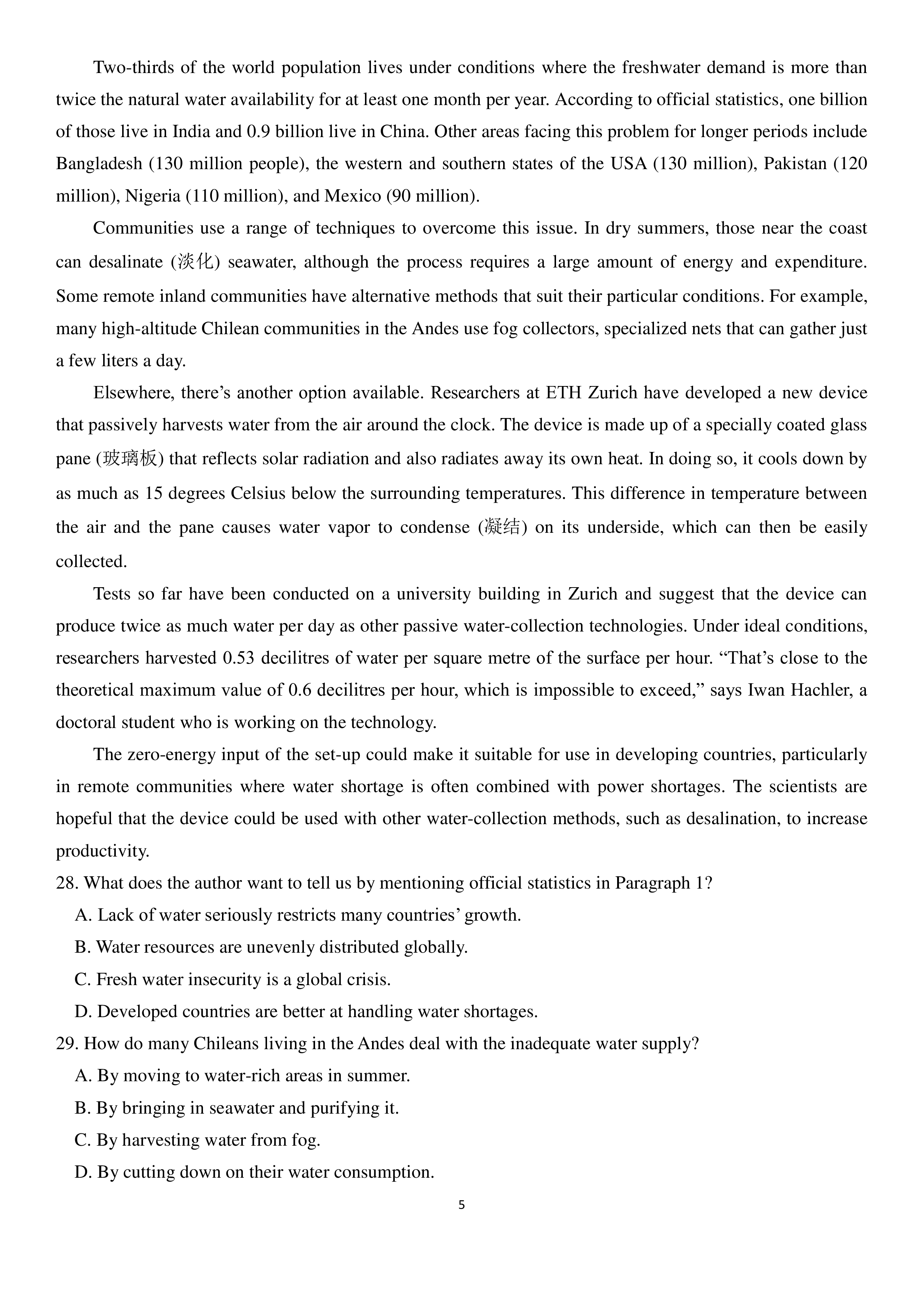 Two-thirds of the world population lives under conditions where the freshwater demand is more thantwice the natural water availability for at least one month per year.According to official statistics,one billionof those live in India and 0.9 billion live in China.Other areas facing this problem for longer periods includeBangladesh (130 million people),the western and southern states of the USA (130 million),Pakistan (120million),Nigeria (110 million),and Mexico(90 million).Communities use a range of techniques to overcome this issue.In dry summers,those near the coastcan desalinate (seawater,although the process requires a large amount of energy and expenditure.Some remote inland communities have alternative methods that suit their particular conditions.For example,many high-altitude Chilean communities in the Andes use fog collectors,specialized nets that can gather justa few liters a day.Elsewhere,there's another option available.Researchers at ETH Zurich have developed a new devicethat passively harvests water from the air around the clock.The device is made up of a specially coated glasspane (that reflects solar radiation and also radiates away its own heat.In doing so,it cools down byas much as 15 degrees Celsius below the surrounding temperatures.This difference in temperature betweenthe air and the pane causes water yapor to condense (on its underside,which can then be easilycollected.Tests so far have been conducted on a university building in Zurich and suggest that the device canproduce twice as much water per day as other passive water-collection technologies.Under ideal conditions,researchers harvested 0.53 decilitres of water per square metre of the surface per hour."That's close to thetheoretical maximum value of 0.6 decilitres per hour,which is impossible to exceed,"says Iwan Hachler,adoctoral student who is working on the technology.The zero-energy input of the set-up could make it suitable for use in developing countries,particularlyin remote communities where water shortage is often combined with power shortages.The scientists arehopeful that the device could be used with other water-collection methods,such as desalination,to increaseproductivity.28.What does the author want to tell us by mentioning official statistics in Paragraph 1?A.Lack of water seriously restricts many countries'growth.B.Water resources are unevenly distributed globally.C.Fresh water insecurity is a global crisis.D.Developed countries are better at handling water shortages.29.How do many Chileans living in the Andes deal with the inadequate water supply?A.By moving to water-rich areas in summer.B.By bringing in seawater and purifying it.C.By harvesting water from fog.D.By cutting down on their water consumption.
本文标签: